
Air Busan Baggage Allowance, Check-in & Seats
 Huiwon Kim (Check Kim)2026-11-216 min read
Every photo in this post was taken on site by Check Kim.
- Free checked bag
- Special/Event none · Value/Normal 15kg
- Carry-on
- 1 bag up to 10kg + 1 laptop bag or small handbag
- Counter closes
- Domestic 30 min · international 50 min before departure
- Merger
- Folding into Jin Air in March 2027
Contents · 7
Air Busan's cheapest fares include no checked bag; Value and Normal fares include 15kg. Carry-on is 10kg, and day-of seats are free.
How much luggage Air Busan includes depends on the fare. Special and Event fares include no free checked bag, while Value and Normal fares include 15kg. You can carry on one bag up to 10kg plus a laptop bag or small handbag, and seats are assigned free of charge on the day of departure. Everything below reflects Air Busan's official site as of November 2026, so double-check on the official site before you book.
Because baggage comes and goes with the fare, picking the right fare at booking matters more on Air Busan than on airlines with a flat allowance. Here's what to know about baggage, check-in deadlines, seat fees, meals and the FLY & STAMP program.
Who is Air Busan?
Air Busan is a South Korean low-cost carrier based at Gimhae International Airport in Busan. It flies domestic routes and short- to medium-haul international routes to Japan, China, Taiwan and Southeast Asia, plus some international flights from Daegu. If you're starting a trip in Busan or the southeast of Korea, it's often the most convenient budget option.
Air Busan is merging with Jin Air and Air Seoul, and the combined airline is set to launch as Jin Air in March 2027. Korea's transport ministry and Fair Trade Commission approved the deal in November 2026; Jin Air survives as the company and Air Busan is absorbed. Jin Air has pledged to make Gimhae a second hub and add international routes there. How stamps and baggage rules will change after the merger hasn't been announced, so treat this guide as Air Busan's pre-merger rules.
Baggage allowance
Whether checked baggage is included depends on the fare. The cheapest Special and Event fares include none on any route, so check this before you pick a fare if you're bringing a suitcase.
Type | Special / Event | Value / Normal | Max size |
|---|---|---|---|
Domestic checked | None | 15kg (infants: none) | 203cm total |
International checked (excl. Guam, Saipan) | None | 15kg, infants 10kg | 203cm total |
Guam / Saipan checked | None | Guam 2 × 23kg, Saipan 1 × 23kg, infants 10kg | 158cm total |
Carry-on | 1 bag up to 10kg + 1 small bag | 1 bag up to 10kg + 1 small bag | 115cm total |
Bags over 203cm in total dimensions or 32kg are restricted. Travelers with an infant under 2 can check one stroller, car seat or similar item for free. The carry-on can't exceed 40 × 20 × 55cm on any side, or it won't be allowed in the cabin.
Buying extra baggage on the website or app costs less than paying at the airport. Prices vary by route, so check the excess baggage page.
Check-in
Online and mobile check-in works on all domestic routes and on international flights departing Korea or Japan (Guam excluded). Domestic check-in runs until 30 minutes before departure, and international check-in from 2 days to 1 hour 30 minutes before departure. Flights departing Japan only allow it for Korean citizens aged 19 or over.
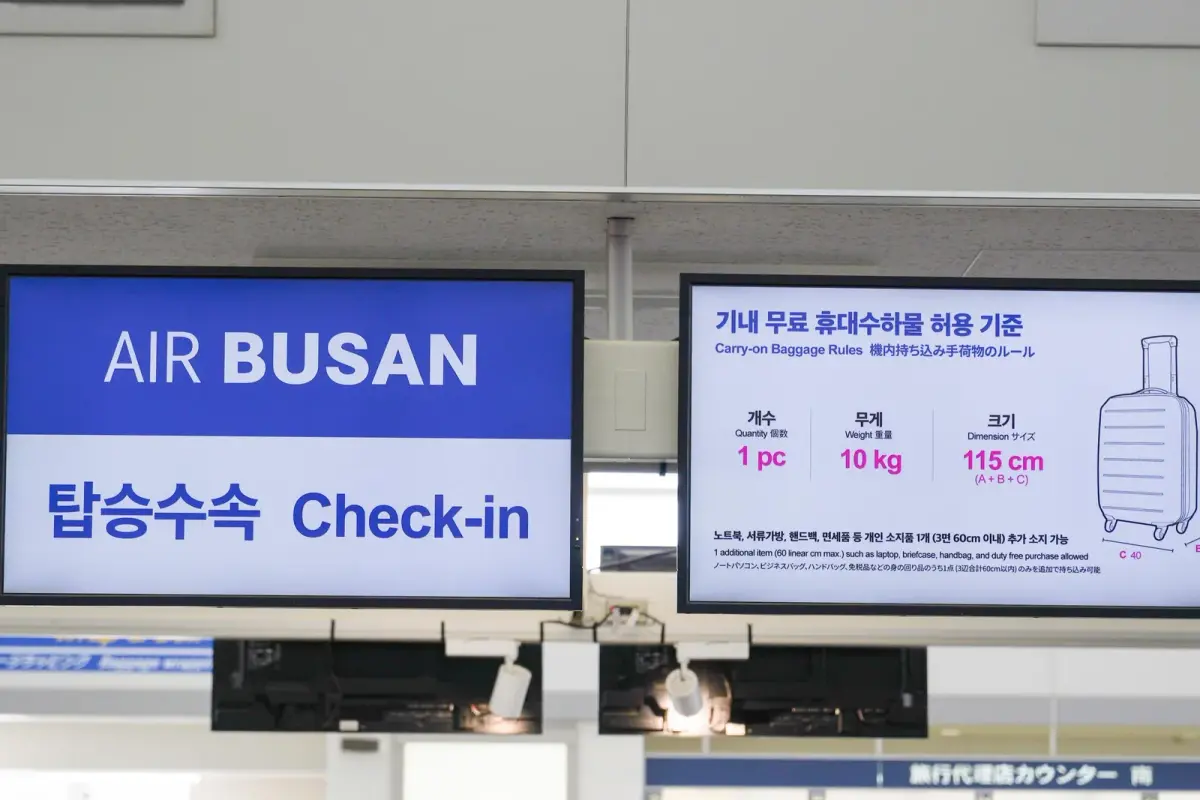
Airport check-in closes 30 minutes before domestic flights and 50 minutes before international flights. Air Busan recommends arriving 40 minutes early for domestic flights, 2 hours for international flights from Busan and 3 hours from Incheon. If you're checking a bag, drop it at the counter before security.
Seat selection
Choosing a seat in advance costs extra. Paid seats can be bought and refunded until the day before departure, and on the day itself you can get a seat assigned for free. If no seats are open online, the counter assigns one at check-in. On Busan, Gimpo and Ulsan to Jeju flights, every seat is free.
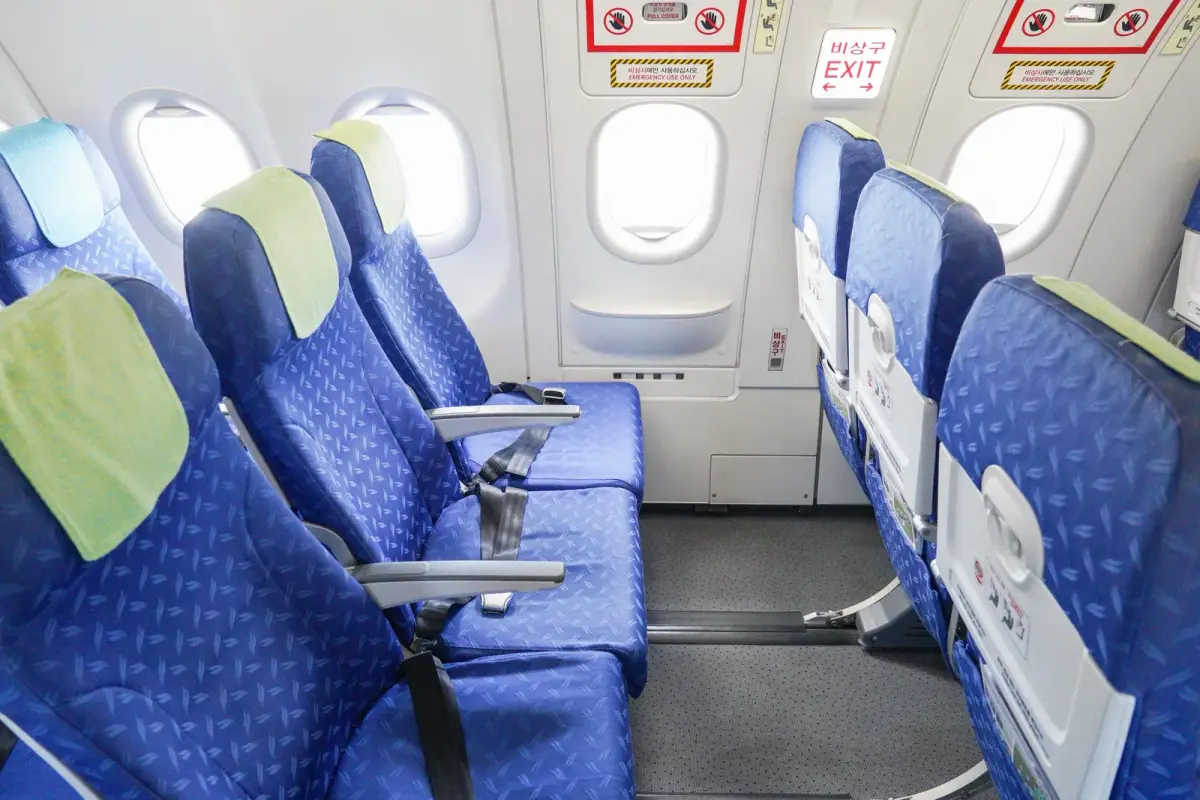
Online prices as of November 2026, one way per seat:
Seat | Domestic (Busan–Gimpo) | Japan |
|---|---|---|
Front row / exit row | about $8 | $17 |
Standard A | about $5 | $10 |
Standard B | about $3 | $6 |
Routes to China, Taiwan, Hong Kong and Southeast Asia cost more, and buying at the airport or through the call center costs more than online. See the seat purchase page for every route. Exit-row seats are only for passengers able to assist the crew in an emergency.
Meals and extras
Meals aren't free on Air Busan. You can pre-order one per person on the website up to 3 days before your first departure; from 2 days out it can't be cancelled or refunded. Prices start at around $12 depending on the menu and route.
International flights from Busan and Daegu also sell food and drinks on board through the CAFE BLUE service. What's sold, and whether anything is complimentary, varies by route, so check the in-flight service page for your flight. Bundles combining baggage, seats and meals are also available.
FLY & STAMP
Air Busan's loyalty program is FLY & STAMP. Fly on a ticket bought through Air Busan's own website or app and you earn stamps per one-way flight; children and infants don't earn. Tickets bought through the call center, at the airport, through travel agents or online travel agencies, and Special or Event fares don't earn stamps.
Route (one way) | Stamps earned | Stamp award (off-peak / peak) |
|---|---|---|
Domestic | 1 | 20 / 25 |
Osaka, Fukuoka, Matsuyama, Takamatsu, Kagoshima | 2 | 30 / 35 |
Tokyo, Sapporo, Qingdao, Taipei, etc. | 3 | 40 / 45 |
Hong Kong, Macau, Guangzhou | 4 | 50 / 55 |
Da Nang, Bangkok, Cebu, Guam, etc. | 5 | 60 / 65 |
Bali | 6 | 70 / 75 |
Stamps are valid for one year from the flight date, and you can buy or receive transferred stamps if you're short (purchased stamps last 60 days). Stamp awards can only be booked on the website or app, and you still pay airport taxes and fuel surcharges. What happens to stamps after the merger hasn't been announced.
Before you book
The baggage gap between Air Busan's Special fares and its Value or Normal fares is big. If you're checking a bag, compare the total cost both ways, and decide whether to wait for a free seat on departure day or pay to pick one. To compare with other Korean budget airlines, see our Korean LCC comparison and the Jin Air baggage guide.
FAQ
Do all Air Busan fares include a free checked bag?
How much carry-on can I bring on Air Busan?
Do I have to pay to pick a seat on Air Busan?
How does FLY & STAMP work?

Written by
Huiwon Kim (Check Kim)Founder, TripFlowy · Travel Creator
Travel creator on the road since 2007. Known as Check Kim (책킴) in Korea, boarded 64 flights in 2025 alone. 20+ trips to Japan, with personally tested spots across 50+ cities in 20+ countries in Asia, Europe and the Americas. Writes about theme parks, airport transit, observation decks, and day-trip routes from major cities.
Comments